A payment cannot be processed on the website due to a limit, because the amount exceeds the daily limit for iDEAL, the monthly spending limit on
your credit card, or the limit set by the bank itself.
Check your banking app or online banking to view your limits and temporarily increase them if necessary.
Possible limits and solutions:
Digital daily limit (e.g., iDEAL): Many banks have a daily limit for online payments that you can adjust yourself in your banking app or online banking.
Credit card spending limit: This is the maximum amount you can spend on your credit card each month. Both payments and reservations are deducted from this amount.
Bank limits: Your bank may block transactions if unusual patterns are detected, such as large amounts, frequent payments, or payments made in unusual locations.
What you can do:
Check your banking app: Go to your banking app or online banking to check your current daily and monthly limits.
Temporarily increase the limit: Adjust your limit to a higher amount to make the purchase.
Be aware of the waiting period: After increasing a digital limit, there is often a four-hour waiting period before the new limit takes effect. This is to protect against fraud.
Contact the bank: If you cannot complete the payment, contact your bank to ask if there is a hold on your account or to inquire about the reason for the declined transaction.
An error message stating “Authentication error – incorrect information entered” means
that the system cannot verify your identity, usually due to an incorrect username or password. To resolve this, carefully re-enter your login credentials, check your internet connection, and ensure that the date and time on your device are correct. If the problem persists, you may need to reset your password or contact customer service.
OXY BV
We accept all online payment methods:
Apple Pay, credit and debit card payments, PayPal, Klarna, iDEAL, Bancontact, SEPA transfer, i3, bank cards, EPS, PostePay, Giropay, KBC/CBC, Belfius, Przelewy24, Visa, Mastercard, Maestro -American Express
Bank transfer
IBAN NL78ABNA0570709423
BIC ABNANL2A
If you would like to receive an invoice first, please select bank transfer.
![]()
OXY BV
-Orders are shipped via DHL. We strive to ship items in stock within 1–2 days of receiving payment or confirmation of payment.
-Delivery time: 3-6 business days for items in stock at the supplier
.-Free shipping on orders over €150-If the item
is in stock at the manufacturer, the delivery time is a maximum of 5 business days. If there is a backorder at the manufacturer, you will receive an email with the expected delivery
date-You will receive an email from us containing the tracking number. (DHL partners with Bpost in Belgium.)
If the delivery person does not find you at home, they should leave a note for you.
We also offer the option to have your order delivered to a different address. You can specify this when entering your address details.
If a problem arises during the warranty period, you will always receive a free replacement system. You also don’t have to worry about additional shipping costs. Even after the warranty period expires, you remain our valued customer, and we are happy to assist you.
Yes, as a private individual, you can purchase an oxygen concentrator without a prescription.
Place the oxygen concentrator 0.30 to 0.60 meters away from walls and furniture. The device needs to draw in oxygen and expel exhaust gases, so it requires plenty of space. Make sure the area around it is clear.
- The oxygen concentrator not only needs space for air to circulate, but also gets very hot, which can pose a fire hazard if placed near objects such as furniture
or curtains. - Connect the bottle from your humidifier if necessary. Insert the screw cap from your humidifier bottle into the outlet of your oxygen concentrator. Slowly tighten the bottle until it is securely attached to the device.
- Always use distilled or filtered water in your humidifier bottle. Unscrew the cap on top of the bottle and fill the bottle with water. Screw the cap back on before attaching the bottle to your oxygen concentrator. Change the water every time you use the device
. - You will likely be prescribed a humidifier bottle if your doctor prescribes an oxygen flow rate of more than
2–3 liters per minute (LPM). - Connect your oxygen tubing to the humidifier bottle or to an adapter. If you are using a humidifier bottle, you will see a port on the bottle. This is where you insert the oxygen tubing. If you are not using a humidifier bottle, use an oxygen adapter, also known as a Christmas tree adapter, to connect your tubing. It looks like a small funnel, with a wide end and a pointed end.
- The oxygen adapter fits into the outlet on your machine that you would normally use for a humidifier bottle. Simply insert the larger end of the adapter into the outlet. In most cases, you just push the adapter into the outlet. If you encounter any issues, consult your machine’s manual. -
Make sure your air filter is in place. Your oxygen concentrator has an air intake filter that removes particles and allergens from the air. It should be located on the side of your device. You may occasionally need to remove or replace the filter, so always double-check that it’s there before turning on your device.
- You should remove the filter from the back or side of your oxygen concentrator once a week. Wash it in warm water and then squeeze out the excess water. Pat it dry with a clean towel before putting it back in your device. -
Start your oxygen concentrator at least 15–20 minutes before use. It takes a while for your oxygen concentrator to start producing the correct concentration of oxygen. This means you need to have it running for a while before you start breathing in the oxygen it produces. Plan accordingly.
- To determine exactly how long your device needs to run before the oxygen concentration is correct, follow the instructions for your model or your doctor’s guidance.
Plug it into a grounded outlet that is not currently in use. Your oxygen concentrator should be the only device plugged into that outlet, as it draws a lot of power. If your outlet is not grounded, it is safe to use an adapter
. - Some older outlets only have holes for the typical side-by-side prongs on an electrical cord, but your oxygen concentrator has a third round prong on the plug.
- Do not use an extension cord, as this can cause a fire.
- Set the on/off switch to the "on" position. The switch should say "on/off," but it may also say "start." The lights will turn on, and you will hear the sound of air being drawn in and expelled.
- Make sure the device is in the "off" position before plugging it into the outlet. It may be damaged if it is already "on."
Listen for the alarm. Your oxygen concentrator should sound an alarm when it is turned on. This is to ensure that it is not accidentally turned on when not intended. After a few seconds, the alarm will stop.
- The alarm will sound every time the oxygen concentrator is turned on.
- You will also hear an alarm if the power is interrupted.
- Locate the flow control knob or switch on your oxygen concentrator. The appearance of your knob may vary, but it should be the main knob or switch on your device. It may be labeled for liters per minute (LPM) or levels, such as 1, 2, 3, etc.
- The button or switch likely has numbers next to it, though the exact markings depend on your model.
- Consult your machine’s manual to make sure you’re using the correct knob or switch.
- Turn the knob or switch until it is set to the prescribed number. Your doctor will prescribe the correct amount of oxygen. If you are unsure which setting to use, call your doctor for clarification.
- It is very important that you use the correct amount of oxygen, so do not guess.
- Do not use more or less oxygen than your doctor has prescribed. Using the wrong oxygen setting can be harmful. Follow all of your doctor’s instructions!
- If you think you’re not getting the right amount of oxygen, talk to your doctor. Do not adjust your oxygen settings yourself.
- Check your tubing for kinks or bends. These can interrupt the oxygen flow, so smooth them out if you find any. It’s fine if your tubing has a slight curve, like a large circle, as long as the air can flow freely.
- If there is a kink in the tubing, you may not be getting all the oxygen you need. You may need to replace your tubing if it is not straight.
- Place your mask over your face when oxygen levels are low. Make sure there are no gaps around the edges of the mask. Place the elastic strap on the mask over your head or around your ears, depending on the type of mask.
- Adjust the mask until it feels comfortable.
- Adjust the mask if it shifts or comes loose.
- Insert the nasal cannula into your nostrils for high oxygen levels. Each end of the cannula should curve upward into one nostril. Once the ends are in place, loop the tubes over your ears. Adjust the tubes under your chin by sliding the tube adjuster up or down.
- Place your nasal cannulas in water to check if they are working. Look for bubbles forming as air flows through the tubes.
- Adjust the tubes until they feel comfortable when you insert the nasal cannula.
- Breathe through your mask or nasal cannula. Breathe in as you normally would and let the device provide supplemental oxygen. Use the device for as long as your doctor recommends.
- Turn off the device when you are not using it. Press the same button you use to turn it on. The device can overheat if left on, creating a fire hazard. It is important not to leave the device on when it is not in use.
Please contact us if you have any questions
.
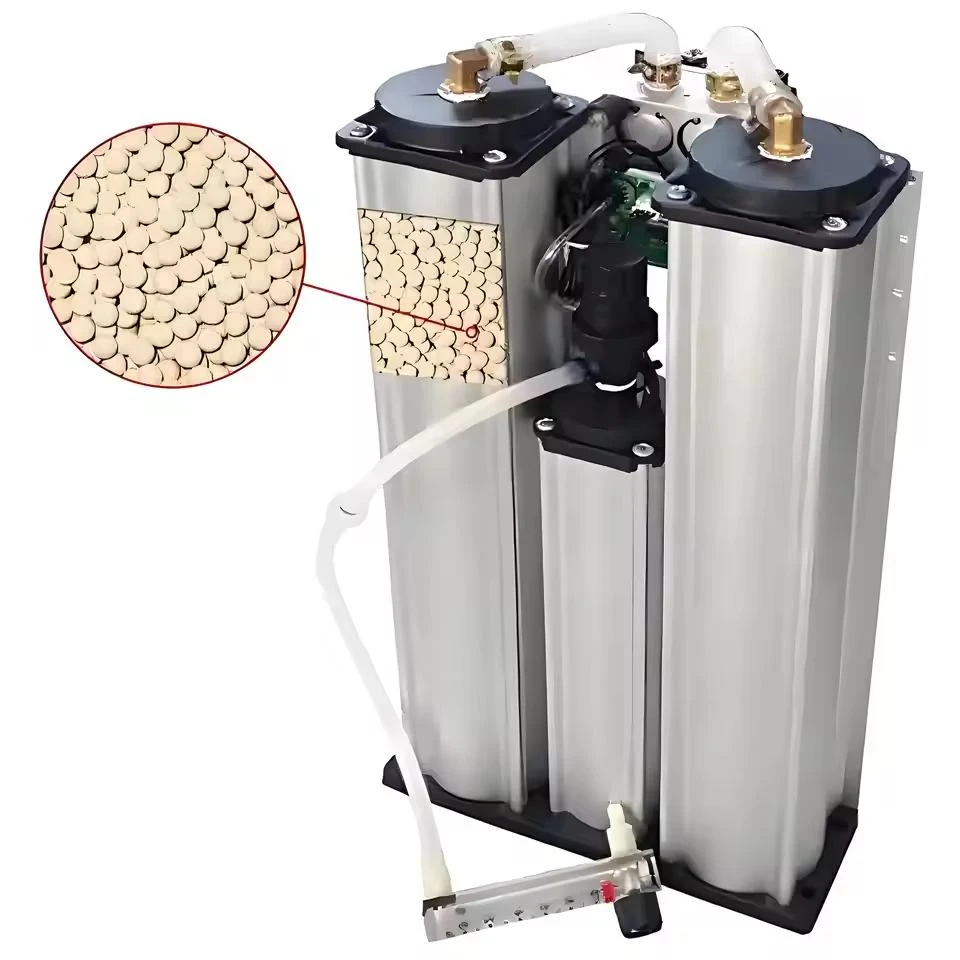
The oxygen concentrators use Pressure Swing Absorption (PSA).
Ambient air is drawn in by a compressor, compressed, and passed through a molecular sieve. The molecular sieve traps the nitrogen present in the ambient air (approx. 79% by volume) and releases the remaining oxygen.
Before the molecular sieve becomes saturated with nitrogen, the system switches to a second molecular sieve. While the second sieve provides oxygen enrichment, the first sieve can regenerate. This process repeats continuously. Switching between the sieves causes a hissing sound. The alternating regeneration of the two sieves enables continuous oxygen enrichment.
Preparing the oxygen concentrator for use:
Important
points– The company supplying the equipment and oxygen is responsible for ensuring the proper functioning of the equipment. The company also provides clear written instructions for the use and maintenance of the equipment and ensures an adequate supply of oxygen
.– Due to the fire-promoting effect of oxygen, a number of safety measures must be taken.
– The oxygen concentrator must be freestanding and placed at least 15 cm away from walls, curtains, and floor coverings.
– When using 4–5 liters of oxygen per minute or more, a humidifier bottle is recommended in consultation with the doctor. This prevents irritation of the mucous membranes
.– Oxygen supply hoses must be replaced if visibly contaminated
.– The intake filter must be checked and, if necessary, cleaned (see the user manual for the specific device).
Complications during the procedure
Procedure
The alarm does not sound after turning on the oxygen concentrator. Turn off the device, turn on the flowmeter, and wait until the ball drops to zero. Then turn the oxygen concentrator back on. If the alarm still does not sound, consult the supplier.
The alarm sounds for longer than 1 minute. Check: whether the plug is in the outlet, if the air intake filter is clogged, if there is a heat source too close to the oxygen concentrator, or if there is insufficient space around the oxygen concentrator. If any of these issues are the cause, turn off the oxygen concentrator, let it cool for 10 minutes, and then turn the oxygen concentrator back on.
The oxygen concentration is not optimal. Check whether the flowmeter is turned on; if not, notify the supplier.
Supplies– oxygen
concentrator– if necessary: humidifier, possibly with an
adapter– user manual for the oxygen
concentrator– oxygen supply tube
Procedure
1 Place the supplies within reach.
2 Position the oxygen concentrator so that the intake filter on the side of the housing can draw in ambient air unobstructed.
3 If applicable, attach the humidifier to the oxygen outlet (using the supplied adapter if necessary, depending on the type of oxygen concentrator).
4 Check that the plug is plugged into the outlet.
5 Press the on/off switch. A light will come on and all functions of the oxygen concentrator will be checked. You will also hear the alarm signal for a few seconds (see the user manual for the meaning of the different lights; this depends on the type of oxygen concentrator).
6 Set the flowmeter according to the oxygen concentrator’s user manual. The device requires a 5-minute warm-up time to reach the optimal oxygen concentration.
7 Set the flowmeter to the prescribed oxygen flow rate. The center of the ball in the flowmeter indicates the exact number of liters per minute.
8 Connect an oxygen supply tube to the flowmeter.
9 Check the set dosage regularly during the first 30 minutes after turning on the device and adjust it if necessary.
10 Put away the remaining materials.
11 Record the procedure and any findings.
Daily:
• Clean the oxygen
concentrator• Check
the nasal cannula (nasal prongs)• Change the water in the humidifier bottle. Fill between the minimum and maximum marks (distilled water)
• Rinse the humidifier bottle and cap with clean, warm water.
• Rinse the outside of the nasal cannula under lukewarm running water, holding the open ends downward so that no water can enter.
Weekly:
• Clean the humidifier bottle and cap with mild soap and water.
• Rinse the humidifier bottle and cap under running water to remove all soap residue.
• Wipe parts dry with a clean cloth or let them air dry.
• Wipe the surface of the device with a clean, damp tissue. Use a mild cleaning agent.
• Clean
the dust filter (back) every week or when clogged• Checking extension hoses
Regular use of the concentrators ensures that the filter beds are less susceptible to wear.
Stationary concentrators
: Turn these on once a week for at least one hour.
Portable oxygen concentrator
: Turn this on once a week for at least one hour.
If you are not using the portable concentrator, remove the battery and place it next to the device.
Every 14 days:
• The oxygen concentrator should be cleaned with a damp cloth.
• Clean the dust filter on the back.
• Replace the nasal cannula every 14 days
Every 30 days:
• Replace the humidifier
bottle Every 60 days:
• Replace the extension tubes
every 2 to 3 months Every year:
• Replace the dust filter (at the rear)•
Replace
the internal filter (inside)• O2
test• Clean the oxygen
concentrator• Report and advice
Nasal cannulas, extension tubes, and humidifier bottles are disposables and are available from OXY BV.
OXY BV is not liable for failure to perform regular maintenance on oxygen concentrators supplied by OXY BV or by third parties.
The ball on the flow meter of an oxygen concentrator should be read at the center and should be at the level corresponding to the prescribed setting in liters per minute (LPM). This indicates the correct flow rate. A higher position of the ball means a higher flow rate, and a lower position means that less oxygen is being delivered. You should only adjust the flow rate on the advice of your healthcare provider.
How to read the ball
Turn on the concentrator: turn on the device and wait until the ball is stable.
Find the center of the ball: look at the center of the ball. This is the point you use to read the flow rate.
Align the line: The center of the ball must be at the same height as the line indicating the number of liters per minute (LPM) prescribed by your doctor.
Adjust if necessary: If the ball is not aligned with the correct line, use the flow regulator to adjust it until it is. Do not change the flow rate unless your doctor asks you to.
Why is the reading important?
Correct dosage: The correct position of the bulb ensures that you receive exactly the amount of oxygen prescribed by your doctor, which is crucial for your health.
Safety: An incorrect position can lead to insufficient oxygen supply or waste of resources if the flow rate is too high.
Medical advice: It is essential that you use only the flow rate prescribed by your doctor. Changes should only be made under his supervision.
The popping sound is caused by nitrogen and carbon dioxide escaping from the device, and it is a normal part of its operation.
If an oxygen concentrator beeps, first check the power supply, for a kink in the tubing, a clogged nasal cannula or filter, and whether the flow tube is set correctly. A continuous beep often indicates a power issue, while an intermittent beep is more likely caused by an obstruction. Check the warning lights and contact a professional if problems persist. Power supply
issues
Check the plug:
Make sure the plug is securely inserted into the outlet. Plug the device directly into the outlet and do not use an extension cord.
Power outage:
A continuous beep may indicate a power outage or a dead battery, if the concentrator has a battery. Airflow
issues
Check the oxygen tubing: Make sure
the tubing is not kinked or blocked.
Check the nasal cannula or mask: Make sure the nasal cannula or mask fits properly and is not blocked.
Check the air filter: A dirty or clogged filter can obstruct the airflow. Clean the filter weekly with a vacuum cleaner and replace it regularly.
Check the flowmeter: Make sure the ball in the flow tube is set to the correct setting and not at zero.
Warning lights
Inspect the lights: Pay attention to the warning lights (yellow, orange, or red), as these indicate issues such as power problems, overheating, or low oxygen purity.
Reset the device: Sometimes it helps to turn the device off and then back on.
When to contact a professional?
If the solutions above do not work, contact your supplier or nurse for assistance.
Pulse Flow
With every breath you take, the portable oxygen concentrator delivers a "bolus" (puff) of oxygen exactly when you need it most. The pulse flow detects the pressure of each breath through the nasal cannula to deliver the exact dose you need, at the exact moment you need it. 95% of people can manage with this.
Continuous flow
If you need a constant, steady, and reliable flow of oxygen, you need continuous flow. Set your device to the liters per minute prescribed by your doctor, and you can be sure of an uninterrupted flow of oxygen.
Warnings and Precautions
A warning indicates a risk of injury to the operator or the patient.
• To function properly, your concentrator requires unobstructed ventilation. The ventilation ports are located on the back of the unit, at the bottom, and near the air intake filter on the side. Keep the device at least 15 to 30 cm away from walls, furniture, and especially curtains that could obstruct proper airflow to the device. Do not place the concentrator in a small enclosed space
(such as a closet).
• Do not remove the protective covers from this device. Maintenance must be performed by a certified and trained home care provider.
• In the event of a device alarm or if you experience any discomfort, you must immediately notify your home care provider and/or medical specialist.
• The oxygen generated by this concentrator is supplemental and should not be considered life-saving or life-sustaining. Under certain circumstances, oxygen therapy can be dangerous; all users should seek medical advice before using this device.
• If the prescribing medical specialist has determined that an interruption in the oxygen supply (for any reason) could have serious consequences for the user, an alternative oxygen source must be available for immediate use.
• Oxygen significantly accelerates the combustion process and must be kept away from heat and open flames. Not suitable for use in the vicinity of flammable anesthetic mixtures with air, oxygen, or nitrous oxide.
• No one (including yourself) should smoke near the concentrator while the device is in use; open flames
must also be kept away.
• Do not use oil or grease on the concentrator or its components: these substances, when combined with oxygen, can greatly increase the risk of fire or personal injury.
• Do not use the oxygen concentrator if the plug or power cord is damaged. Do not use extension cords or electrical adapters.
• Do not clean the concentrator while the plug is connected to the power outlet.
• Using the device at a voltage, LPM value, humidity level, and/or altitude higher than or outside the specified range may reduce the oxygen concentration level.
• Your home care provider is responsible for preventive maintenance at periodic intervals recommended by the device manufacturer.
Points to Note
: “Caution” indicates a risk of damage to the device.
• Do not place liquids on or near the device.
• If liquid is spilled on the device, turn off the power and unplug the device from the outlet before cleaning up the spill. Call your home care provider if the device is no longer functioning properly.
Normal oxygen saturation is typically
between 95% and 100%. This means there is sufficient oxygen in the blood, carried by hemoglobin in the red blood cells. A value below 90% is considered low (hypoxemia) and may indicate a lack of oxygen, which can cause symptoms such as shortness of breath and fatigue.
What is a normal saturation level?
Between 95% and 100%: This is a healthy and normal saturation level for most people.
Below 95%: This can still be normal for certain people, such as those with lung disease, the elderly, or people living at high altitudes.
During sleep: Levels may be slightly lower during sleep than during the day.
For lung patients: For people with lung disease who are receiving oxygen, a target level of 92–93% may be normal.
When should you be concerned?
Below 90%: This is considered a severe oxygen deficiency (hypoxemia) and requires medical attention. Symptoms may include shortness of breath, confusion, or restlessness.
Between 90% and 95%: It is advisable to monitor these levels and contact a primary care physician for consultation.
How is it measured?
A pulse oximeter, a small device often clipped onto a finger, measures the oxygen level in the blood.
The meter uses LED lights to calculate how much oxygen is in your blood and displays this as a percentage
Too much oxygen can lead to symptoms such as headaches, drowsiness, irritability, and impaired consciousness, especially in people with a medical condition who are prescribed supplemental oxygen. This occurs because it can suppress breathing and cause carbon dioxide to build up in the blood. When using oxygen therapy, it is therefore crucial to follow the prescribed dosage and contact a doctor immediately if you experience any symptoms.
Oxygen is not flammable, but it causes other materials to burn much more intensely and quickly.
Contact with flammable substances: Oil, grease, and alcohol can spontaneously ignite in oxygen-rich environments.
Ignition sources: Smoking, open flames, hot surfaces, electrical devices, and even friction can serve as ignition sources.
Unsecured cylinders: A falling cylinder can become a projectile, cause an explosion, and trigger spontaneous combustion due to the oxygen.
Safety precautions
No smoking: Ensure that no one smokes near the oxygen source, including e-cigarettes. Post a "No Smoking" sign.
Avoid contact with grease/oil: Do not use ointments or lotions containing oil or grease near oxygen equipment. Use only water-based products, such as the supplier’s nasal gel, if necessary.
Ventilate the room: Ensure good ventilation by keeping windows and vents open.
Secure cylinders: Secure oxygen cylinders to a wall, table, or chair with brackets so they cannot tip over.
Notify authorities: Inform the fire department and your home insurance provider about the oxygen supply in your home.
Follow the rules: Always follow the safety instructions provided by your oxygen supplier.
The MDR, or Medical Device Regulation, is a European regulation that has been in effect since May 26, 2021, and establishes new rules for medical devices and in vitro diagnostic medical devices. This regulation replaces the previous MDD (Medical Device Directive) and aims to ensure the safety and performance of medical devices and increase transparency for patients.
Key points of the MDR:
Stricter requirements:
The MDR imposes stricter requirements on manufacturers, importers, and distributors of medical devices than the previous MDD.
CE marking:
Medical devices may only be placed on the European market if they bear a CE marking, which demonstrates that they meet the requirements of the MDR.
Strengthened market authorization system:
The MDR strengthens the system for the market authorization of medical devices, with a greater emphasis on safety and performance.
Greater transparency:
The MDR promotes transparency for patients and healthcare providers through improved traceability of devices and more product information.
Oversight:
The Health and Youth Care Inspectorate (IGJ) in the Netherlands has been designated as the supervisory authority for compliance with the MDR.
What does the MDR mean for healthcare providers and patients?
Healthcare providers:
Must be aware of the new rules and ensure that the medical devices they use meet the MDR requirements.
Patients:
Are entitled to clear information about the medical devices they use and can have greater confidence that these devices are safe and effective.
In short, the MDR is an important step toward greater safety and transparency in the world of medical devices, with implications for manufacturers, healthcare providers, and patients.
All oxygen concentrators we offer comply with the European Medical Device Regulation (MDR).
TRAVELING WITH YOUR CONCENTRATOR
The FAA permits this device on board most U.S. and European aircraft.
IMPORTANT: It is the patient’s responsibility to consult the specific airline when traveling domestically and internationally.
When traveling with the device, you must bring the AC adapter and the external battery charger (if you have one). It is recommended to use external power (i.e., plugged into a wall outlet) whenever available to keep the battery fully charged.
Bring enough charged batteries to power your concentrator for no less than 150% of the expected duration of your flight, ground time before and after the flight, security checks, connections, and a conservative estimate for unexpected delays. Note that according to FAA regulations, all spare batteries must be individually wrapped and protected to prevent short circuits and may only be carried in carry-on luggage on board the aircraft.
The AC power supply cannot be used to charge the device’s battery on board the aircraft.
If you are traveling by bus, train, or boat, contact your carrier to inquire about the availability of power outlets.
We have listed the most frequently asked questions on this page. If you have a question and cannot find the answer here, please email or call us.
oxy@oxy.nl and Tel. 0031708903526